468x60 Ads

Showing posts with label BitcoinMagazine. Show all posts

Wednesday, June 5, 2019

Op Ed: Debunking Bitcoin Myths: ‘It’s a Ponzi Scheme’

The accusation that bitcoin is nothing more than a Ponzi scheme is perhaps the oldest, longest-standing criticism of the digital bearer asset. The basic idea is that there is nothing of value here and the entire purpose of bitcoin’s existence is to enrich Satoshi Nakamoto and the speculators who bought in for a few pennies or dollars in the early days by tricking others into buying in at a higher price.

The key characteristic of a Ponzi scheme is that returns promised to early investors in a nonexistent enterprise are paid out with money put into the scheme by later investors. These sorts of scams fall apart when there are simply no new people to scam into “investing” in the project. At that point, the early investors stop receiving a return on their initial investment and it becomes clear the whole scheme was based on lies and deceit rather than some sort of legitimate investment strategy or product.

Bitcoin is clearly not a Ponzi scheme for two key reasons: (1) bitcoin exists to provide real value and utility to its users, and (2) bitcoin does not require new investment to keep working.

Bitcoin’s Utility Doesn’t Require New Investment

I’ve already debunked the argument regarding bitcoin’s supposed lack of intrinsic value in a separate article, but it’s important to cover that again as it’s also part of the Ponzi scheme claim. In a Ponzi scheme, there is no product, business plan or investment strategy that leads to returns. Instead, the money to pay old investors comes from new investors.

With bitcoin, investors are simply utilizing or speculating on the price of a digital money. Over the years, bitcoin has illustrated its value as an apolitical digital money, and those who are buying it today are using it as a money — or at least as a store of value.

Additionally, bitcoin doesn’t need new users to enter the system at all for current users to benefit. Notably, bitcoin’s current 3.8 percent emission rate will drop to around 1.9 percent after next year’s halving event.

In a world with that low rate of supply growth and a constant user base (no old users leave and no new users arrive), a bitcoin user should be able to purchase more goods and services than they could have with that same bitcoin a few years earlier due to the inevitable increased efficiencies of the global economy provided by improvements in technology and other factors.

In other words, bitcoin would be providing real utility as a store of value in this hypothetical scenario.

It should also be remembered that bitcoin’s emission rate will continue to be cut in half every four years until all of the bitcoin that will ever exist have been minted, at which point the emission rate becomes 0 percent.

All Forms of Money Are Ponzi-esque

Many different arguments have been made around bitcoin as a Ponzi scheme over the years, but the one made by Nobel Prize-winning economist and New York Times columnist Paul Krugman in January 2018 is the perfect example for debunking another aspect of the Ponzi scheme claim.

In his post on the matter, Krugman pointed to the words of fellow Nobel Laureate Robert Shiller and referred to bitcoin as nothing more than a bubble that would eventually end badly for everyone holding the asset:

“But what about the fact that those who did buy bitcoin early have made huge amounts of money? Well, people who invested with Bernie Madoff also made lots of money, or at least seemed to, for a long time.

“As Robert Shiller, the world’s leading bubble expert, points out, asset bubbles are like ‘naturally occurring Ponzi schemes.’ Early investors in a bubble make a lot of money as new investors are drawn in, and those profits pull in even more people. The process can go on for years before something — a reality check, or simply exhaustion of the pool of potential marks — brings the party to a sudden, painful end.”

What Krugman writes here isn’t wrong. But the key issue with his argument is that it also applies to every other form of money, including his favored U.S. dollars. As AngelList co-founder Naval Ravikant has said in the past, money is a bubble that never pops.

It should be remembered that the U.S. dollar was bootstrapped as a money through an initial tie to gold. There was at least some connection between U.S. dollars and gold until then U.S. President Richard Nixon closed the gold window in 1971.

With this in mind, it’s useful to take Krugman’s arguments against bitcoin and apply them to gold. Sure, gold has some non-monetary use cases (e.g., electronics and jewelry), but the vast majority of its value comes from the widespread speculation that it is useful as money (or at least a store of value).

In other words, those who were early to see gold’s value as a form of money benefited as that point of view became more prevalent around the world. Now, what does that sound like?

So, Krugman is correct to bring up the “naturally occurring Ponzi scheme” argument when it comes to bitcoin. And the International Monetary Fund (IMF) has also made that claim in the past.

The gold Ponzi scheme was the original basis for the U.S. dollar’s value, and now its value is based on the U.S. government’s ability to properly manage the world’s most liquid and popular reserve currency. Will that last forever? History indicates that it won’t.

This means, on a long enough time scale, the U.S. dollar is a Ponzi scheme too.

The post Op Ed: Debunking Bitcoin Myths: ‘It’s a Ponzi Scheme’ appeared first on Bitcoin Magazine.


Watchtowers Are Coming to Lightning

“The Eye of Sauron casts its gaze upon the Lightning Network.”

This is how Lightning Labs CTO Olaoluwa Osuntokun (aka, roasbeef) has heralded the coming of Watchtowers to the Lightning Network. Though comparing the technical feature to the demonic gaze of Tolkien’s primary antagonist sounds disconcerting, the analogy holds up on the surface: Watchtowers, as the name implies, will keep an eye on Lightning Network channels and potential bad actors.

Why the need for them? Well, if you’re using a custodial Lightning wallet, there isn’t one. But if you’re running your own channels with your own node, then there’s the slim but conceivable chance that the party on the other side of your channel could cheat you when the channel is closing.

For instance, say Molly has a channel with Angela and they each deposit 10,000 sats into it, for a total of 20,000 sats. During the channel’s lifetime, Angela pays Molly 5,000 sats, bringing the total to 15,000 sats for Molly and 5,000 for Angela.

But suddenly, for whatever reason, Molly is unable to access her Lightning wallet (maybe her node is offline, her computer has a malfunction or she’s on vacation), so Angela decides to be a bit mischievous — when it comes time to broadcast the final state of the channel to the blockchain, she decides to broadcast the first state of the channel (the original 10,000 sat balances that they both deposited) to cheat Molly out of what she was paid.

Since Molly is on a remote island in the Gulf of Mexico and not at her computer, she can’t check Angela’s bad behavior and verify the actual state of the channel, so she loses 5,000 sats.

Not the end of the world but still a bummer.

A Check on Bad Behavior

Watchtowers effectively neutralize this threat by monitoring payment channels and the blockchain to make sure acts of fraud don’t slip through unnoticed. They work like this:

Every time a channel’s state is updated, the payment produces an encrypted “blob” for each channel user, which is basically a secret signature that corresponds to the user’s public key, and sends it to the watchtower. At the same time, the watchtower receives half of the transaction ID of the channel’s previous state, and this acts as a decryption key for the blob. The watchtower stores all of these blobs and decryption keys within its database, so if an impish actor tries to broadcast an older state to the mempool, the watchtower will see that the transaction ID matches up with the other transaction ID half it holds. Now that it has both halves of this transaction ID, the watchtower can decrypt the corresponding blob and punish the bad actor by sending the funds to the honest channel user’s wallet.

All of this can be done without the watchtower knowing who the channel users are and how much is being transacted in the channel beforehand (obviously, once the transaction is broadcasted on-chain, the public key and the fund amount is revealed).

“They don’t know anything about a client’s payment history; instead, the client sends them an encrypted blob that can only be decrypted if a breach actually happens,” Osuntokun told Bitcoin Magazine.

Technical innovators have floated the concept for a while, but Lightning Labs’ Lightning Network Daemon (LND) implementation of the technology is the first production-ready iteration available, though Osuntokun said that it is still very much in its infancy.

“It can be used on mainnet as is today, but it’s still at an early phase. We’ve been running the set of changes on our nodes for a few months now, but only until this week did we put out the public pull request,” he told Bitcoin Magazine.

In the initial rollout, the default version features so-called “altruistic” watchtowers, meaning that they operate without promise of payment for their services. Osuntokun said that it also features an operational “basic reward watchtower,” which would allow the watchtower to charge a fee if it acts on a breach, but this has to be activated manually.

The service, Osuntokun continued, is opt-in for both clients and the watchtower operators themselves, and clients have to manually search for towers if they want to make use of them. In the future, the team plans to implement an “automatic discovery system” to streamline this process.

While the initial version will rely on the good graces of watchers to keep users honest, free of charge, Lightning Labs has a three-stage plan for letting watchers monetize their service. The first is the altruistic phase, followed by a reward system, which will be variable depending on market factors like how much watchtowers charge and how much clients are willing to pay. Lastly, Lightning Labs is devising a mechanism that will allow users to prepay for a given number for backups of their payment channel states.

“When it is integrated, it will probably resemble a Chaumian scheme where you pay via Lightning to acquire blinded tokens redeemable at the tower,” Conner Fromknecht, head of cryptographic engineering at Lightning Labs, told Bitcoin Magazine.

This token scheme, Fromknecht continued, also has some nifty uses for whitelisting participants while maintaining privacy. If a watchtower operator only wanted to serve their friends, for instance, they could “authenticate users up front but from then on it wouldn’t be able to pinpoint which users are renewing or backing up to the tower” because the tokens are “blinded” and payments can’t be traced to a particular user.

Osuntokun said that the primary cost for running a watchtower is storage, though the 1 TB hard drives users would need to run a Lightning node are fairly cheap at $40 and the blobs watchtowers need to store are “only a few hundred bytes.” Now, depending on how many channels a watchtower decides to monitor, this data burden becomes heavier; one channel obviously requires less space than 100 or 1,000 channels would.

Still, storage space is a bit of a trade-off, Osuntokun said, one that sacrifices storage for privacy since “the tower doesn’t know which channel it’s watching, so it ends up using more storage space.” Another tricky piece of building the technology, he said, is finalizing the automatic discovery protocol for finding towers and devising the e-cash token so towers can be paid for each state update. Right now, they can only be paid if they catch a user cheating.

Another hurdle is hash time locked contracts (HTLC), Fromknecht expressed. For the first release, only manually closed channels can be monitored for the sake of privacy and efficiency. Lightning Labs plans to add support for HTLC monitoring in the future, though, which will “prevent an attacker from claiming them after the relative timelock elapses,” Fromknecht said.

Still, even with this room for improvement, the implementation is a big step toward making Lightning safer and trustless.

“With what’s implemented in the to-be-merged pull request, any routing node, application or business on the network can start to run their own private tower to back up their public node. This can be a standalone instance or a more advanced deployment on dedicated hardware,” Osuntokun said.

So the best-case scenario with this technology, actually, is that every user has their own Eye of Sauron watching over their Lightning channels in the future — and that’s actually a very good thing.

The post Watchtowers Are Coming to Lightning appeared first on Bitcoin Magazine.


How Elliptic’s Blockchain Analysis Brings Visibility to Crypto Transactions

Gone are the days when bitcoin was synonymous with drug deals and the dark net. Today, many ordinary people understand that bitcoin is a digital currency with many legitimate uses.

Yet the fact that bitcoin has largely outlived the nefarious reputation of its early days does not mean that avoiding association with criminal activity has ceased to be a concern for companies operating in the crypto industry. On the contrary, as more and more mainstream investors and institutions explore the crypto market, it has become all the more important for businesses that work with bitcoin or other cryptocurrency to have the right programs in place to track and identify crypto risks, make smart decisions and continue to deliver safe and trusted crypto services.

Doing so is critical not just for staying ahead of regulatory compliance requirements, but also for instilling confidence in customers and business partners in order to grow in the fast-moving crypto industry.

Bitcoin and Criminal Activity

Illegal activity may no longer be the only thing that most people associate with bitcoin. But concerns about illegal activity remain a barrier in many cases for banks. It’s easy to understand why, given continuing headlines about criminal activity in the crypto ecosystem. Bitcoin exchanges can be an easy way to launder money. Loosely regulated Bitcoin transactions can help criminals defraud investors. Bitcoin is a handy payment mechanism for bomb-scare extortionists.

Perceptions of the crypto ecosystem as a target for criminals erode the trust of banks in businesses that work with crypto. This makes it hard for these businesses to gain access to mainstream banking services, which are important for helping them to grow.

It’s a problem for banks themselves, too. The crypto and fiat economies are increasingly merging. As a recent Fidelity survey shows, for example, many more mainstream investors are now interested in crypto assets. As a result, banks are facing mounting pressure to be able to make sure that the crypto businesses they work with are operating legitimately in order to help support those investors.

And while this investor interest grows, risk protection needs to evolve as well. It behooves those who may be entering the cryptocurrency space from more traditional fields to thoroughly look into both the direct and indirect risks they face and to develop a comprehensive process for risk identification and mitigation from there.

Upon this introspection, many groups realize the potential of advanced blockchain analytics. This risk mitigation solution can help users accurately assess the risks of the cryptocurrency space and make more confident decisions about how to manage them.

Enter Elliptic

But leveraging advanced blockchain analytics properly is no easy task. Bitcoin users are spread across the world, and they are constantly growing in numbers (making the safe adoption of crypto services all the more critical).

At the same time, government regulations and regulatory activity surrounding crypto are quickly increasing in scope and complexity. In March, AUSTRAC, the Australian Anti-Money Laundering (AML) regulator, suspended the licenses of two crypto exchanges that facilitated the operations of organized criminals involved in drug dealing on the dark web. As a result, the two exchanges are no longer able to conduct business in Australia. AUSTRAC used the opportunity to remind Australian exchanges of their AML obligations, such as the requirement to detect and report suspicious transactions.

On April 10, the New York Department of Financial Services (NYDFS) declined Bittrex’s application for a BitLicense, requiring Bittrex to cease operations in New York State. The denial letter sets out NYDFS’s high AML compliance expectations for any crypto businesses seeking to provide services in New York State, including using appropriate transaction monitoring systems. Also, Japan’s Financial Services Agency (JFSA) undertook on-site examinations of two Japanese exchanges, reviewing the quality of their AML controls in response to changes in management at each of the companies.

Also in April, the U.S.’s Financial Crimes Enforcement Network (FinCEN) imposed a $35,000 fine and a ban on trading activities against an individual acting as an unlicensed peer-to-peer exchange business. FinCEN cited failure to have appropriate AML policies and procedures, and failure to report suspicious transactions, as motivation for the action against the crypto broker.

In order to help banks comply with this growing set of regulations, Elliptic is building a platform that enables banks and businesses to gain more visibility into crypto transactions and identify illicit activity on the blockchain. By pairing machine learning with a proprietary cybercrime database to identify patterns that could signal fraud, money laundering or other crimes, Elliptic helps organizations stay ahead of the ever-changing strategies that criminals use in the crypto industry. It provides safeguards against unwitting participation in money-laundering schemes, terrorist fundraising and other financial crimes that can threaten the reputations of well-meaning businesses in the crypto industry.

Part of Elliptic’s purpose is to help organizations comply with AML financial regulations, which require them to take steps to detect and combat money laundering and fraud. But Elliptic’s vision — and its importance for the crypto ecosystem — extends far beyond the narrow purview of AML compliance. As noted above, identifying illicit activity in the crypto ecosystem is important not just for improving bitcoin’s image or keeping regulators happy. It’s key to enabling banks and businesses in the space to continue to grow and to gain the confidence of the investors and customers who are essential to that growth.

In short, a solution for banks to identify illicit activity related to crypto is critical if the crypto industry is to keep growing, and if the crypto ecosystem is to continue merging with the fiat economy. Banks need a way of protecting themselves against criminals who take advantage of the relative anonymity of bitcoin to commit fraud, money laundering and other crimes. Elliptic provides that solution, enabling companies not just to meet compliance requirements, but to manage risks and boost their confidence in delivering safe and trusted services in the blockchain-based economy unhindered by the threat of crime.

The post How Elliptic’s Blockchain Analysis Brings Visibility to Crypto Transactions appeared first on Bitcoin Magazine.


Monday, June 3, 2019

Op Ed: Debunking Bitcoin Myths: ‘It’s a Ponzi Scheme’

Bitcoin Pyramid

The accusation that bitcoin is nothing more than a Ponzi scheme is perhaps the oldest, longest-standing criticism of the digital bearer asset. The basic idea is that there is nothing of value here and the entire purpose of bitcoin’s existence is to enrich Satoshi Nakamoto and the speculators who bought in for a few pennies or dollars in the early days by tricking others into buying in at a higher price.

The key characteristic of a Ponzi scheme is that returns promised to early investors in a nonexistent enterprise are paid out with money put into the scheme by later investors. These sorts of scams fall apart when there are simply no new people to scam into “investing” in the project. At that point, the early investors stop receiving a return on their initial investment and it becomes clear the whole scheme was based on lies and deceit rather than some sort of legitimate investment strategy or product.

Bitcoin is clearly not a Ponzi scheme for two key reasons: (1) bitcoin exists to provide real value and utility to its users, and (2) bitcoin does not require new investment to keep working.

Bitcoin’s Utility Doesn’t Require New Investment

I’ve already debunked the argument regarding bitcoin’s supposed lack of intrinsic value in a separate article, but it’s important to cover that again as it’s also part of the Ponzi scheme claim. In a Ponzi scheme, there is no product, business plan or investment strategy that leads to returns. Instead, the money to pay old investors comes from new investors.

With bitcoin, investors are simply utilizing or speculating on the price of a digital money. Over the years, bitcoin has illustrated its value as an apolitical digital money, and those who are buying it today are using it as a money — or at least as a store of value.

Additionally, bitcoin doesn’t need new users to enter the system at all for current users to benefit. Notably, bitcoin’s current 3.8 percent emission rate will drop to around 1.9 percent after next year’s halving event.

In a world with that low rate of supply growth and a constant user base (no old users leave and no new users arrive), a bitcoin user should be able to purchase more goods and services than they could have with that same bitcoin a few years earlier due to the inevitable increased efficiencies of the global economy provided by improvements in technology and other factors.

In other words, bitcoin would be providing real utility as a store of value in this hypothetical scenario.

It should also be remembered that bitcoin’s emission rate will continue to be cut in half every four years until all of the bitcoin that will ever exist have been minted, at which point the emission rate becomes 0 percent.

All Forms of Money Are Ponzi-esque

Many different arguments have been made around bitcoin as a Ponzi scheme over the years, but the one made by Nobel Prize-winning economist and New York Times columnist Paul Krugman in January 2018 is the perfect example for debunking another aspect of the Ponzi scheme claim.

In his post on the matter, Krugman pointed to the words of fellow Nobel Laureate Robert Shiller and referred to bitcoin as nothing more than a bubble that would eventually end badly for everyone holding the asset:

“But what about the fact that those who did buy bitcoin early have made huge amounts of money? Well, people who invested with Bernie Madoff also made lots of money, or at least seemed to, for a long time.
“As Robert Shiller, the world’s leading bubble expert, points out, asset bubbles are like ‘naturally occurring Ponzi schemes.’ Early investors in a bubble make a lot of money as new investors are drawn in, and those profits pull in even more people. The process can go on for years before something — a reality check, or simply exhaustion of the pool of potential marks — brings the party to a sudden, painful end.”

What Krugman writes here isn’t wrong. But the key issue with his argument is that it also applies to every other form of money, including his favored U.S. dollars. As AngelList co-founder Naval Ravikant has said in the past, money is a bubble that never pops.

It should be remembered that the U.S. dollar was bootstrapped as a money through an initial tie to gold. There was at least some connection between U.S. dollars and gold until then U.S. President Richard Nixon closed the gold window in 1971.

With this in mind, it’s useful to take Krugman’s arguments against bitcoin and apply them to gold. Sure, gold has some non-monetary use cases (e.g., electronics and jewelry), but the vast majority of its value comes from the widespread speculation that it is useful as money (or at least a store of value).

In other words, those who were early to see gold’s value as a form of money benefited as that point of view became more prevalent around the world. Now, what does that sound like?

So, Krugman is correct to bring up the “naturally occurring Ponzi scheme” argument when it comes to bitcoin. And the International Monetary Fund (IMF) has also made that claim in the past.

The gold Ponzi scheme was the original basis for the U.S. dollar’s value, and now its value is based on the U.S. government’s ability to properly manage the world’s most liquid and popular reserve currency. Will that last forever? History indicates that it won’t.

This means, on a long enough time scale, the U.S. dollar is a Ponzi scheme too.

This article originally appeared on Bitcoin Magazine.


Watchtowers Are Coming to Lightning

Lightning Watchtowers

“The Eye of Sauron casts its gaze upon the Lightning Network.”

This is how Lightning Labs CTO Olaoluwa Osuntokun (aka, roasbeef) has heralded the coming of Watchtowers to the Lightning Network. Though comparing the technical feature to the demonic gaze of Tolkien’s primary antagonist sounds disconcerting, the analogy holds up on the surface: Watchtowers, as the name implies, will keep an eye on Lightning Network channels and potential bad actors.

Why the need for them? Well, if you’re using a custodial Lightning wallet, there isn’t one. But if you’re running your own channels with your own node, then there’s the slim but conceivable chance that the party on the other side of your channel could cheat you when the channel is closing.

For instance, say Molly has a channel with Angela and they each deposit 10,000 sats into it, for a total of 20,000 sats. During the channel’s lifetime, Angela pays Molly 5,000 sats, bringing the total to 15,000 sats for Molly and 5,000 for Angela.

But suddenly, for whatever reason, Molly is unable to access her Lightning wallet (maybe her node is offline, her computer has a malfunction or she’s on vacation), so Angela decides to be a bit mischievous — when it comes time to broadcast the final state of the channel to the blockchain, she decides to broadcast the first state of the channel (the original 10,000 sat balances that they both deposited) to cheat Molly out of what she was paid.

Since Molly is on a remote island in the Gulf of Mexico and not at her computer, she can’t check Angela’s bad behavior and verify the actual state of the channel, so she loses 5,000 sats.

Not the end of the world but still a bummer.

A Check on Bad Behavior

Watchtowers effectively neutralize this threat by monitoring payment channels and the blockchain to make sure acts of fraud don’t slip through unnoticed. They work like this:

Every time a channel’s state is updated, the payment produces an encrypted “blob” for each channel user, which is basically a secret signature that corresponds to the user’s public key, and sends it to the watchtower. At the same time, the watchtower receives half of the transaction ID of the channel’s previous state, and this acts as a decryption key for the blob. The watchtower stores all of these blobs and decryption keys within its database, so if an impish actor tries to broadcast an older state to the mempool, the watchtower will see that the transaction ID matches up with the other transaction ID half it holds. Now that it has both halves of this transaction ID, the watchtower can decrypt the corresponding blob and punish the bad actor by sending the funds to the honest channel user’s wallet.

All of this can be done without the watchtower knowing who the channel users are and how much is being transacted in the channel beforehand (obviously, once the transaction is broadcasted on-chain, the public key and the fund amount is revealed).

“They don't know anything about a client’s payment history; instead, the client sends them an encrypted blob that can only be decrypted if a breach actually happens,” Osuntokun told Bitcoin Magazine.

Technical innovators have floated the concept for a while, but Lightning Labs’ Lightning Network Daemon (LND) implementation of the technology is the first production-ready iteration available, though Osuntokun said that it is still very much in its infancy.

“It can be used on mainnet as is today, but it's still at an early phase. We've been running the set of changes on our nodes for a few months now, but only until this week did we put out the public pull request,” he told Bitcoin Magazine.

In the initial rollout, the default version features so-called “altruistic” watchtowers, meaning that they operate without promise of payment for their services. Osuntokun said that it also features an operational “basic reward watchtower,” which would allow the watchtower to charge a fee if it acts on a breach, but this has to be activated manually.

The service, Osuntokun continued, is opt-in for both clients and the watchtower operators themselves, and clients have to manually search for towers if they want to make use of them. In the future, the team plans to implement an “automatic discovery system” to streamline this process.

While the initial version will rely on the good graces of watchers to keep users honest, free of charge, Lightning Labs has a three-stage plan for letting watchers monetize their service. The first is the altruistic phase, followed by a reward system, which will be variable depending on market factors like how much watchtowers charge and how much clients are willing to pay. Lastly, Lightning Labs is devising an e-cash token that lets users pay for space for a series of uploads which can be exchanged for bitcoin through the Lightning Network.

“When it is integrated, it will probably resemble a Chaumian scheme where you pay via Lightning to acquire blinded tokens redeemable at the tower,” Conner Fromknecht, head of cryptographic engineering at Lightning Labs, told Bitcoin Magazine.

This token scheme, continued, also has some nifty uses for whitelisting participants while maintaining privacy. If a watchtower operator only wanted to serve their friends, for instance, they could “authenticate users up front but from then on it wouldn’t be able to pinpoint which users are renewing or backing up to the tower” because the tokens are “blinded” and payments can’t be traced to a particular user.

Osuntokun said that the primary cost for running a watchtower is storage, though the 1 TB hard drives users would need to run a Lightning node are fairly cheap at $40 and the blobs watchtowers need to store are “only a few hundred bytes.” Now, depending on how many channels a watchtower decides to monitor, this data burden becomes heavier; one channel obviously requires less space than 100 or 1,000 channels would.

Storage space is also a bit of a trade-off, Osuntokun continued, one that sacrifices storage for privacy since “the tower doesn't know which channel it’s watching, so it ends up using more storage space.” Another tricky piece of building the technology, he said, is finalizing the automatic discovery protocol for finding towers and devising the e-cash token so towers can be paid for each state update. Right now, they can only be paid if they catch a user cheating.

Another hurdle is hash time locked contracts (HTLC), Fromknecht expressed. For the first release, only manually closed channels can be monitored for the sake of privacy and efficiency. Lightning Labs plans to add support for HTLC monitoring in the future, though, which will “prevent an attacker from claiming them after the relative timelock elapses,” Fromknecht said.

Still, even with this room for improvement, the implementation is a big step toward making Lightning safer and trustless.

“With what's implemented in the to-be-merged pull request, any routing node, application or business on the network can start to run their own private tower to back up their public node. This can be a standalone instance or a more advanced deployment on dedicated hardware,” Osuntokun said.

So the best-case scenario with this technology, actually, is that every user has their own Eye of Sauron watching over their Lightning channels in the future — and that’s actually a very good thing.

This article originally appeared on Bitcoin Magazine.


Friday, May 31, 2019

Op Ed: Bitcoin in Africa, What Needs to Be Done to Encourage Adoption?

Bitcoins

Bitcoin has the potential to revolutionize the African continent. Through Bitcoin, millions of unbanked Africans will have access to financial services.

These and many more such statements exist across the internet. All these statements are true. But, despite all the benefits that Bitcoin is expected to bring to African countries, adoption levels in Africa continue to be the lowest globally.

Which begs the question, “If Bitcoin is to help Africa catch up with the rest of the world, what is preventing Africans from adopting the cryptocurrency?”

Why Is Africa Lagging in Bitcoin Adoption?

Africans are interested in bitcoin and other cryptocurrencies. Nigerians account for the highest number of searches for the keyword “Bitcoin.” However, this peak in interest does not appear to be translating to increased adoption rates.

Why is this?

One of the main factors limiting bitcoin adoption in Africa is the availability or lack of regulations. African governments either have introduced strict regulations limiting bitcoin use or have not introduced any legislation to govern cryptocurrencies.

In countries such as Zimbabwe, the government introduced strict regulations against cryptocurrencies, which resulted in Golix — the country’s only crypto exchange — shutting down its bitcoin ATMs.

In countries where crypto regulation is still absent, citizens are exposed to a multitude of scams, which makes them wary of bitcoin. In Uganda, for example, bitcoin scams have been on the rise, which has resulted in legislators calling for regulation of crypto assets.

The lack of regulation also plays a part in bitcoin’s market volatility. Generally speaking, early bitcoin adopters had a high-risk appetite. However, most people hate the uncertainty that results from the lack of regulations, which has contributed to the lag in bitcoin adoption in Africa.

Lack of Awareness

Bitcoin is still a foreign concept to many Africans. This lack of awareness is another factor contributing to the low rates of bitcoin adoption in Africa. A very small percentage of Africans has heard of bitcoin. A majority of these are young tech enthusiasts, freelancers and traders.

The higher percentage of the African population has never heard of digital coins. Bitcoin is expected to help the unbanked access financial services. However, how is this to happen if most of this population has never heard of cryptocurrencies?

Putting bitcoin in the hands of this population will contribute greatly to mass adoption in African states. But this cannot be done if the majority of the population does not understand bitcoin.

The lack of awareness of bitcoin has also made many Africans prone to crypto scams. Many Africans don’t understand how bitcoin works. Scammers use this ignorance to frame bitcoin as a get-rich-quick scheme, which attracts thousands of willing investors. In March 2019, several Kenyans lost their savings after falling for a Brazilian bitcoin con.

Expansive Use of Mobile Money Services Hinders Adoption

Africa is home to over 50 percent of the global mobile money market. In some countries, over 80 percent of the population uses mobile money services. This high proliferation of mobile money is a major contributor to the failure of many Bitcoin-based startups in Africa.

For you to send or trade bitcoin, you need to have a smartphone and access to the internet. Mobile money services, on the other hand, allow one to send or receive money through text messages, a feature that works even on the most basic telephone handset.

Although internet access has been on the rise in Africa, the majority of the population still lacks access to stable internet connections, which results in them preferring the more accessible mobile money services.

Bitcoin will undoubtedly transform the African continent. However, to achieve this transformation, several changes need to occur within the continent and among Bitcoin-based startups.

The Introduction of Bitcoin-Friendly Regulations

Many crypto enthusiasts are against the idea of introducing crypto and blockchain regulations. To these individuals, regulation means to control, and bitcoin was created to be free from any centralized control.

On the other hand, regulation can also mean to make something “regular.” It can help bring order to a chaotic situation. Currently, bitcoin is considered a risky investment, especially in Africa, where many have fallen prey to scams in the past.

The mass adoption of bitcoin in Africa will need the majority of the population to have access to the cryptocurrency and feel confident using it. The only way to achieve this is by giving people the perception that bitcoin is safe; the introduction of crypto-friendly regulations is necessary for this to happen.

Bitcoin is a borderless currency. This feature limits a nation’s ability to regulate it. Rather than regulating the cryptocurrency, policymakers can introduce laws to govern startups and apps using bitcoin.

Educational Workshops Can Help Promote Bitcoin Adoption in Africa

Bitcoin adoption in Africa largely depends on Africans understanding the benefits that the cryptocurrency offers. Startups working with Bitcoin in Africa should conduct educational workshops across the continent to ensure people understand the technology.

Most of the unbanked population in Africa don’t have access to basic internet services. To these people, Bitcoin is still a foreign concept that they only hear about in the news, and in most instances, it’s usually bad news.

Educational workshops would help dispel any negative myths about Bitcoin. If people understand that bitcoin is not a scam, but a new form of currency that is easier to transfer and is free from government-related economic depressions; adoption resistance will reduce.

Integration With Mobile Money

Mobile money has achieved widespread success in Africa. Two-thirds of the sub-Saharan population currently use mobile money services. For Bitcoin to achieve widespread adoption in African countries, startups need to integrate Bitcoin and mobile money.

M-Pesa and Ecocash are the dominating mobile money services in Africa. Any startup dealing with Bitcoin should integrate these mobile money options in their platform.

Take the example of Kenya’s M-Pesa. The mobile money service allows Kenyans to send money via text messages. M-Pesa also has a wide network of agents spread across the country. Bitcoin-powered startups that have integrated their services with M-Pesa have experienced higher levels of adoption.

Kipochi, a bitcoin wallet that allowed Africans to send and receive bitcoin, while at the same time allowing the exchange of bitcoin to Kenyan shillings, had integrated M-Pesa to its services. However, after the Kenyan Central Bank cautioned Kenyans against investing in bitcoin, Safaricom, the company behind M-Pesa, canceled the partnership. Before this cancellation, Kipochi was experiencing an increasing number of users. However, the ban resulted in the death of the company.

Wallettec is an example of a startup that has successfully integrated mobile money with digital wallets. This integration has allowed the company to thrive both in South Africa and Kenya.

Africa is a unique market. In the U.S., companies are installing bitcoin ATMs in grocery stores to promote adoption. In Africa, bitcoin ATMs would achieve minimal success — people rarely use bank ATMs. Bitcoin integrated with mobile money is a better option for Africa as it also allows agents to earn from facilitating transactions.

Conclusion

Bitcoin has the potential to transform African countries. However, adoption rates need to increase drastically for this transformation to occur.

Achieving mass adoption of Bitcoin in Africa will require the efforts of both policymakers and private companies; otherwise, the many benefits that Bitcoin is poised to bring to Africa will remain a dream.

This is a guest post by Steven Weru. Opinions expressed are his own and do not necessarily reflect those of Bitcoin Magazine or BTC Inc.

This article originally appeared on Bitcoin Magazine.


Australian Government Publishes Update on Cryptocurrency and ICO Rules

Sydney Australia

The Australian Securities and Investments Commission (ASIC) has published an update on how it intends to regulate crypto-related businesses and initial coin offerings (ICOs).

In this guideline, the financial regulator outlines requirements that need to be followed for cryptocurrency businesses to be compliant with the ASIC Act.

This update is noteworthy as the country continues to battle crypto scams, losing almost $4.3 million in 2018.

Going forward, companies issuing crypto assets deemed to be financial products will be required by law to procure an Australian Financial Services (AFS) license. On the flipside, for crypto assets which aren’t financial products, promoters must ensure that they don’t engage in any form of deceptive advertising.

According to the Corporations Act, an ICO could be a financial product if it's a "managed investment scheme, security, derivative or non-cash payment (NCP) facility," ASIC explains.

Exchanges that manage and offer trading of these assets would also be required to follow the new guidelines, including holding an Australian market license, unless covered by an exemption.

In instances where miners could be considered as a part of the clearing and settlement processes for financial products, Australian laws will apply.

In part, the release notes, “Businesses offering crypto-assets, or offering services in relation to crypto assets, need to undertake appropriate inquiries to satisfy themselves they are complying with all relevant Australian laws.”

Crypto wallet and custody service providers would need the appropriate custodial and depository authorizations to operate, while crypto asset payment and service providers involved in non-cash payment facility require an AFS license.

The agency pointed out that it would be enforcing know-your-customer and anti-money laundering standards on all crypto assets. These cover assets managed within and outside of the country's borders in tandem with the Australian Consumer Law.

ASIC Commissioner John Price said, “Australian laws will also apply even if the ICO or crypto-asset is promoted or sold to Australians from offshore. Issuers of ICOs, crypto-assets and their advisers should not assume the use of these structures means that key consumer protections under Australian laws do not apply or can be ignored.”

This article originally appeared on Bitcoin Magazine.


Man Sentenced for Illegal Money Transmission Services on LocalBitcoins

LocalBitcoins

U.S. citizen Morgan Rockcoons has been sentenced to fines and prison time for running unlicensed money exchange services on LocalBitcoins.

Advertising himself on the peer-to-peer bitcoin trading network, Rockcoons made more than 1,000 transactions with hundreds of different users. The U.S. Department of Justice (DoJ) pursued him on charges of not registering his business with the Financial Crimes Enforcement Network (FinCEN).

Rockcoons’ sentencing marks the end of a somewhat protracted legal battle, following his arrest in February 2018. Rockcoons attempted to sell 10 BTC to an undercover law enforcement officer for $14,500 in cash after the officer explicitly told him that the money was acquired through the production and sale of controlled substances.

The DoJ released information on this case on May 28, 2019, claiming that Rockcoons is to spend “21 months in prison for wire fraud and operating an unlicensed money transmitting business,” in addition to forfeiting over $80,000 in profits.

This marks the continuation of a trend from the U.S. federal government as it ramps up prosecution of bitcoin traders. In April 2019, the DoJ sentenced Joseph Burrell Campos to prison time and an $800,000 fine for similar charges. FinCEN itself began directly pursuing cases of this sort only a week later, levying civil damages against Eric Powers.

As in the Campos case, the DoJ claims that the charges against Rockcoons fall under Homeland Security Investigations’ (HSI) jurisdiction. Another similarity between these two cases is that the DoJ explicitly named LocalBitcoins.com as the mechanism by which both defendants advertised their illegal services. With the site shutting down all operations in Iran in late May 2019 to comply with U.S. sanctions on the country, the site’s operators seem aware of the possibility that legal action could be taken against the service itself.

The DoJ report added that, in this particular case, Rockcoons pled guilty to more than just the unregistered trading of bitcoin. While out on bail in 2018 for the original crime of selling bitcoin without registration, he offered parcels of land for sale in bitcoin. Rockcoons claimed that hundreds of square acres of barren Nevada desert constituted the upcoming real estate development of “Bitcointopia” where bitcoin would be legal tender. Rockcoons did not actually own any of this land.

This article originally appeared on Bitcoin Magazine.


Thursday, May 30, 2019

Exploring Illegal Mining Camps in Western China

Illegal Mining

This article was originally published by 8btc and written by Vincent He.

Although China has shut down bitcoin trading platforms and deemed them illegal, its attitude toward bitcoin mining is still ambiguous. Now, 70 percent of the world’s bitcoins are produced in China, while 70 percent of China’s “stock” are in Sichuan, a western province of China, especially along the Dadu River, where there is plenty of hydropower.

As bitcoin mining requires a lot of electricity, China’s bitcoin mining camps are often located in remote areas with low electricity charges, such as Xinjiang, Yunnan, Inner Mongolia, Sichuan and other regions. As a saying goes, “Sichuan is the natural ‘mining capital’ of bitcoin.”

Due to the fact that nearly 50 percent of the revenue from bitcoin mining is used to pay for electricity, miners have turned to direct power supplies from power plants.

“The cost is very low for the direct power supply of the power station, for it does not need to be integrated into the state grid,” said a senior miner. “Many mines are built directly in or near the power station, and they build their own substations.”

A Chinese bitcoin mine’s factory building cannot be approved, nor can environmental assessments and construction reports. Mines may be suspected of illegal construction and power plants’ direct sales also violate electricity laws.

The shortest factory building is on the Dadu River embankment, only a few meters away from the river surface. The newly built cement wall is isolated from the office building of the power station and connected with a transformer unit separated from the wall of the power station.

Entering the factory building, the water mist emitted from the power plant drifted in and the staff jokingly said, “This is natural cooling water.”

The walls of the buildings in the mine are equipped with large fans running at high speed. In front of the fans in the workshop are dense mining machines. In front of some vacant machines, many workers are busy installing machines.

According to the staff, the mining machines here come from all over the country, mostly from Sichuan, Hunan, Jiangsu, Shenzhen and other regions. The owners keep their own mining machines in the mine camp. They pay the electricity fee, the deposit fee and wait for the coins.

“During the flood season, the mining machines return to Sichuan one after another,” Xiaowu said. Just like migratory birds, the mining machines migrate to Inner Mongolia and Xinjiang in winter and return to Sichuan and Yunnan in summer, where electricity prices are lower.

A mine owner revealed that, because of the slow signing of the power supply agreement with the power plant, building the plant cannot include an environment assessment or construction reporting in advance.

The Municipal Bureau of Land and Resources said that they had known the illegal construction of bitcoin mining camps occurs along the Dadu River. At present, a working group led by the Credit and Economic Bureau has been set up, which is conducting a thorough investigation.

This article originally appeared on Bitcoin Magazine.


Wednesday, May 29, 2019

Bitcoin Price Analysis: Bitcoin Could See Continued Growth if Support Holds

Price Analysis Video.jpg

Summary:

  1. Bitcoin is currently perched between a well-defined band of prices outlined on both the weekly and monthly timeframes.
  2. As we float between the weekly/monthly horizontals, volume is beginning to diminish on both the supply and the demand sides. However, what little supply has surfaced has appeared to be absorbed. If we can maintain support on our weekly $8,200 level, we can expect to see the market push to test the upper boundaries of the resistance in the $9,200 to $9,500 range.
  3. However, if support does not hold and we manage to fall through, we can expect to see a much deeper test and potentially revisit the $6,400 to $6,800 range.

Trading and investing in digital assets like bitcoin is highly speculative and comes with many risks. This analysis is for informational purposes and should not be considered investment advice. Statements and financial information onBitcoin Magazine and BTC Inc sites do not necessarily reflect the opinion of BTC Inc and should not be construed as an endorsement or recommendation to buy, sell or hold. Past performance is not necessarily indicative of future results.

This article originally appeared on Bitcoin Magazine.


BlockFi Adds Gemini Dollar Stablecoin Support

BlockFi

Crypto lender BlockFi is rolling out support for the gemini dollar (GUSD) stablecoin, claiming an expected initial annual percentage yield (APY) of 6.2 percent for non-U.S. customers.

Founded in late 2017, BlockFi is a U.S.-based startup company that issues loans backed by various cryptocurrencies to its users. This practice allows users to generate cash flow without having to permanently sell off particular cryptocurrencies. With the service, investors collateralize the loans with their cryptocurrency holdings and earn interest on these loans.

BlockFi’s recent integration of GUSD is an extension of its already working relationship with Gemini’s services.

“We’ve been working with Gemini as a partner for their custody solution for close to two years,” BlockFi’s founder and CEO Mark Prince told Bitcoin Magazine. “When they launched Gemini Dollar we were immediately interested in bringing it onto the BlockFi platform. The integration process was relatively easy to set up into our dashboard flow.”

Starting with bitcoin and ether, BlockFi has been working to expand its repertoire of available crypto assets for quite some time. Declaring support for litecoin in April 2018, the company also announced its intention to add GUSD to the lineup at the time.

Prince added that this expansion accomplishes two major goals for the future of BlockFi itself.

“The first is as a diversifier of our lending capital which could reduce USD borrowing rates for our clients,” he explained. “The second is that it creates an opportunity for us to work with clients who don’t own crypto yet, but are interested in earning dollar denominated interest from a U.S.-based fintech company.”

Prince suggested that customers “might see bitcoin or other crypto assets being used as ramps into a digital dollar financial ecosystem” if a strong enough demand for the practice materializes.

He also noted that the biggest challenge BlockFi faced with this integration was related to regulation and where GUSD or other stablecoins fit into existing U.S. regulatory frameworks.

“As a result,” he said, “we are not making GUSD in the interest account available in the U.S. market at launch, but expect to have it available in the U.S. before the end of the year.”

In the future, Prince said that the company plans to rollout support for other stablecoins and expects “a variety of financial and payment applications to leverage them.” BlockFi is “very bullish on stablecoins in general and especially reputable, dollar-backed stablecoins like GUSD,” Prince concluded.

This article originally appeared on Bitcoin Magazine.


Chinese Listed Companies and Bitcoin Mining: Partner or Predator?

Mining

This article was originally published by 8btc and written by Lylian Teng.

Some Chinese listed companies have jumped on the bandwagon of bitcoin mining following the bitcoin bull run throughout 2017, either under the guise of cloud computing or providing mining hosting services, in an effort to bypass regulations considering the country’s tough stance on bitcoin.

A recent report indicating that Huatie HengAn, a subsidiary of Chinese publicly listed company Huatie, lost over $23 million for its secret bitcoin mining business has caused quite a stir among investors and triggered investigations from regulators.

In this follow-up report, it’s apparent that more listed companies in China have been involved in cryptocurrency mining, though the country is considering a ban on this “wasteful” activity.

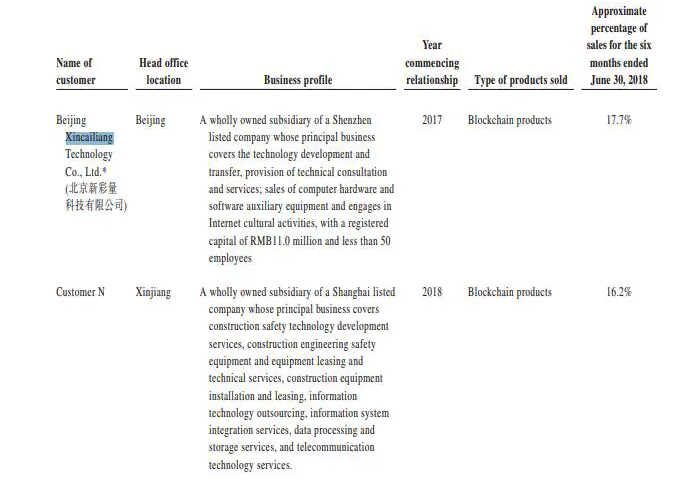
Per a prospectus from leading bitcoin mining machine manufacturer Ebang, its second largest customer, an anonymous Xinjiang-based company, is very likely to be the aforementioned Huatie HengAn, as it fits all the description shown in the prospectus. It is worth noting that its largest client, Beijing Xincailiang Tech, is a subsidiary of Shenzhen-listed technical company Wholeasy. The firm contributed 17.7 percent of Ebang’s miner sales for the first half of 2018.

Chinese Listed Companies in Bitcoin Mining Overseas: Partner or Predator?

Varied from Huatie HengAn, who apparently secretly mined bitcoin in 2018 under the guise of cloud computing, Xincailiang has built crypto mining farms overseas and offers miner host services. But public information shows Xincailiang is mainly engaged in case planning and big data traffic distribution in the field of mobile games in China.

Partner?

In August 2018, Wholeasy released an announcement that Mobcolor Technologies USA LLC, a subsidiary of Xincailiang, had reached a cooperation with California power supplier 3G Venture LLC and Singapore-based enterprise Vast Day Industry Trade Company PTE.Limited (VDIT) to “construct [a] mining center for digital cloud computing.”

According to the agreement, 3G Venture could offer 100,000 square feet for Mobcolor with a rental cost of $18 million per year and 90 MW of power capacity at $0.055/kWh, and Mobcolor’s Chinese parent company bought 65,000 mining rigs from Ebang and then resold them to VDIT who entrusted the mining operation to Mobcolor. The Chinese company’s U.S. subsidiary charged VDIT $0.075/kWh and a $24 million rental fee per year.

Having jumped on the bitcoin mining bandwagon amid the sluggish market in 2018, the company seems quite confident about the prospect of cryptomining.

Predator?

Indeed, Wholeasy is not the only Chinese listed company looking to build mines overseas.

“A plurality of bitcoin mining farms in Iran and the Middle East are run by a company named RHY, which is a NEEQ-listed Chinese company,” a miner named Ma Jingguo said.

According to its official website, RHY is a “large-scale blockchain mine.” It claims to be the largest mining company in the world, having a power supply capacity of 450 MW which could power up to 300,000 miners at the same time.

Chinese Listed Companies in Bitcoin Mining Overseas: Partner or Predator?

“In 2016, the company has invested in the construction of large-scale substations and natural gas power stations in energy-rich countries dominated by the Middle East,” Ma said. “It has become the core blockchain data center with the most competitive electricity rates in the industry. As the majority of its mines are located in Iran, #MininginIran was first hyped by the company.”

It is tough for Chinese companies to conduct bitcoin mining operations both at home and abroad, but they have advantages in capital, talent and other resources over bitcoin mining startups. Their only concern is to be compliant. In such a context, going overseas is a possible solution for them.

Considering the country is tightening its grip on cryptocurrency, these ambitious companies are making big investments overseas in bitcoin mining, a process they believe could secure better returns than crypto pump-and-dump ploys. Will they become big players in the crypto industry in the following years?

This article originally appeared on Bitcoin Magazine.


Hyperloop: A New Concept by Lightning Aiming to Solve Liquidity Problems

Lightning

About two months ago, Lightning Labs released Lightning Loop, a service that allows users to fill or empty Lightning channels without closing them, thus reducing on-chain fees. The service, developed by Lightning Labs developers Alex Bosworth and Bryan Vu, was created to help users manage their liquidity.

The Loop service, says Bosworth, is helpful for managing liquidity because “it sidesteps the liquidity problem for Lightning, which is that you can’t do flow rebalancing. If you run out of channel capacity in one direction, there’s no possibility that you can get more in a totally self contained, only-Lightning world. You need to go outside in order to rebalance.”

So, the natural step for users to mitigate this problem today is to perform a swap, which occurs on-chain and thus requires a transaction fee — and transaction fees on the Bitcoin blockchain can be quite substantial. With the alpha version of Loop available to the public, Bosworth and Lightning Labs had to think about how to make managing liquidity as efficient as possible.

Making Liquidity More Efficient

To address this issue, Bosworth developed a concept called “Hyperloop” as a next step toward solving this problem. Hyperloop is a concept that aggregates swaps so that individual transactions don’t occur on-chain with individualized signatures and outputs. Hyperloop batches inputs together using a method called signature aggregation.

“With signature aggregation, if you can manage to get a bunch of people all together to sign cooperatively, you can take the normal signature cost of moving funds on-chain from however many parties there are on-chain to one signature. I don’t think there’s any limitation to that.”

While this saves costs, one of the requirements is cooperation between many parties over a short period of time, which can be more challenging than it sounds.

Coordinating a Hyperloop Transaction

The Hyperloop concept mediates coordination between so many parties by essentially creating a limited-time, multiparty channel for all parties to join. So, in practice, if there were a lot of users who needed inbound liquidity, a “Loop Out” event would be created using Lightning Loop.

Lightning Loop also acts as a coordinator for these multiparty events, which solves the problem of dealing with malicious actors who might join these events with the intent to mess them up. And it does all of this in a noncustodial fashion.

While Hyperloop offers significant savings for batching the input side of multiple transactions, another big advantage of Hyperloop is savings on output scripts. “The output script, at a minimal level, is only 30 bytes,” says Bosworth. “A normal, on-chain swap is around 300 bytes. So, Hyperloop offers at least 10 times’ savings here.”

Hyperloop also allows for aggregation off-chain as well. For example, if a user has two channels, both 0.1 BTC, and wants to change the balance so that both 0.1 BTC are on the same side, they could ] accomplished this today with two swaps, resulting in two on-chain transactions. This issue of funds sitting on two separate channels can be solved through a proposal called Atomic Multipath Payments (AMPs). Without getting too technical, AMPs essentially allow a user to receive multiple transactions as if they were one, reducing the on-chain cost of sending multiple transactions to the same party.

According to Bosworth, there are two ways to approach AMPs. “Ideally it will be something that we allow with improved signatures like Schnorr, but we also have another way we can do it in the short term called ‘base AMPs,’ and this works really well with Loop.”

As such, base AMPs will be used in Hyperloop as well.

How AMPs Will Benefit Hyperloop

AMPs will benefit individual users who have many open channels. For example, if a user has 100 channels, Hyperloop can be split up between all those channels and wait for all those payments to come through before the swap is executed.

This offers a significant cost savings to another concept called “splicing,” which allows for an on-chain payment (resulting in an on-chain fee) out of a channel without requiring that the channel itself be closed. In this specific use case, a base AMP makes a lot more sense.

Upcoming developments in Bitcoin are a big consideration for all of this tech. Specifically, MuSig, a new multisignature standard that serves as a building block for technologies like Taproot, is the key to achieving these huge savings. Once Schnorr and Taproot are implemented into Bitcoin, MuSig, according to Bosworth, will be helpful in providing a protocol for safe signature aggregation.

As well, it is worth noting that Lighting Labs has also been working on signature aggregation for ECDSA, in case MuSig takes longer to implement than expected.

This article originally appeared on Bitcoin Magazine.